• The site migration is complete! Hopefully everything transferred properly from the multiple decades old software we were using before. If you notice any issues please let me know, thanks! Also, I'm still working on things like chatbox, etc so hopefully those will be working in the next week or two.

The Big Bad Brake Thread

Note all torque numbers are effectively useless except for relative comparative purposes.

This is because the brake proportioning valve rates are unknown.


2003 Pontiac Grand Prix - Specs, Specifications, Data

GTP curb: coupe: 3495 sedan: 3559

weight dist: 65/35

Rotor diameter (in / mm) front: 10.9 / 277; 10.9 / 277

Front force
Tw = 458.85 joules

Rear force
Tw = 346.85 joules

total 805.7 joules

f/r as percent

57/43


2005 Pontiac Grand Prix - Specs

S/C curb: 3583

weight dist: 62/38

Rotor diameter (in / mm) front 11.7 / 297
rear 10.5 / 270

Front force:

Tw = 492.01 joules

Rear force:


http://www.caranddriver.com/var/ezf...lication/cc263b4b5962ba1644eb66f42798e242.pdf

GXP time

curb: 3632

Dist: 63.8/36.2

Front . . . . . . . . . . . . . 12.7 x 1.3-in vented and cross-drilled disc
Rear . . . . . . . . . . . . . . 12.0 x 1.0-in vented and cross-drilled disc

Front force: Tw = 755.60 joules

Rear force: Tw = 332.97 joules


Total: 1 088.57 joules

Dist: 69/31


Thus far: confusing to say the least.


2005 Chevrolet Impala - Specs, Data

SS: 3606

weight dist: 61 / 39

Rotor diameter x thickness (in / mm) front: 11.93 x 1.26 / 303 x 32
rear: 10.9 x .43 / 278 x 11

Front force:
Tw = 500.11 joules

Rear force:
Tw = 346.85 joules

Total: 846.96

Dist (F/R)

59%/41%


2009 Buick LaCrosse - Specs

2009 W body...

Curb: CXL (L26) 3502
Super (LS4) 3770

Weight dis: n/a?

Rotor diameter x thickness (in / mm) Front CX, CXL 11.7 x 1.26 / 297 x 32
Super 12.72 x 1.18 / 323 x 30
Rear CX, CXL 10.6 x 0.55 / 270 x 14
Super
10.94 x 0.43 / 278 x 11

Front force:
CXL:
Super: Tw = 755.60 joules

Rear force:
CXL:
Super: Tw = 332.97 joules


Total:
CXL:
Super: 1 088.57 joules

Dist:
CXL:
Super: 69/31


so if i'm good with just the caliper BRACKET and rotor, y was it listed under slight upgrade for 97-03 that i need the caliper too? or am i just being stupid and reading it wrong?
 
Because you can buy new calipers for dirt cheap then paint them while off the car.

Then swap them on with no downtime waiting for paint to dry.
 
Stock:

Tw = 8273708.75 Pa*0.00019949 m^2*0.5*2*0.278 m

Tw = 458.85 joules

Tw = 338.43 ft lbs.

60 mph, rotor spins at ~1850 RPM.

~119 HP... lulz.
 
I'm thinking of these items for my upgrade. Idea is for new parts, with a tilt toward economy versus performance. All are F-body items.

Calipers w/ brackets: Raybestos FRC10966 & FRC10965------------$120 for 2

Rotors: Raybestos 56641R------------------------------------------$66 for 2

Pads: Wagner MX749 -----------------------------------------------$36


Plus some sort of spacers.

So I am wondering if anybody has suggestions on:

A) Reduce cost without losing much quality or performance
B) Increase performance without increasing cost

According to the writeup this chit will be straight bolt on.


... $36 pads?

You're better off getting good pads and rotors and leaving the calipers stock.

That in itself would be a huge upgrade.

If that still wasn't enough, try 12" rotors.
 
Interesting. Not really looking for a fast wearing pad. Ahhh mind you expensive products sometimes win at more than one game.

Edit: I think the gain in diameter and caliper pressure/distribution is better than high end 11" brakes.
 
Stock:

Tw = 8273708.75 Pa*0.00019949 m^2*0.5*2*0.278 m

Tw = 458.85 joules


F body calipers w/12" rotors:

Tw = 8273708.75 Pa*0.00028274 m^2*0.3*2*0.303 m

Tw = 425.29 joules

Downgrade FTW?
 
1. Why are you not calculating area of a cirlce using A=pi*r^2 ?

2. I thought Tw is torque at the wheel. Why do you have units of Joules, energy there? Cancel units and you can see it is N*m or ft*lb.

3. Can have a more accurate Re by finding the outer effective rotor diameter (well just use outer rotor diameter) and the inner effective diameter and taking their average. Neither of us want to bother with the more appropriate double integral in polar coordinates. Just saying using the effective diametral avg is better than the overall diameter.

4. Why in the post directly above, did you give me COF of 0.5 for the stock setup and COF of 0.3 for the F-body? You should compare a like for like pad compound. We are just trying to find the better mechanics of the two.

When the math is done the Tw is higher for F-body 12" brakes versus 11" stock brakes.

Edit: The assumption that pads are only effective under the piston is incorrect but depends on backing stiffness and proximity to the piston. Wish there was an easier way to account for that.
 
I think there was a guy a while back asking why brake upgrades can reduce stopping distances if the stock setup can already lock the brakes.

Very few cars can lock the brakes at 75MPH in good weather. A GP with 11" brakes certainly isn't one.

Bigger brakes reduce stopping distance for a few reasons, most notably my point directly above, but also the improved response that you get when the ABS is modulating. When ABS is active the braking is on and off.
 
Last edited:


so i dont know if any one will read this, but i am looking to do the f-body upgrade, and i am trying to find all the parts on autozones website.

the thing i am not so sure about is the banjo bolt i need. on there web site they list 2 different ones. one for like the 3.5 vs and one for the 3.9. which one do i get?

and just to check all i need for this upgrade is

1. brake pads
2. rotors
3. calipers
4. disk hardware kit
and i need to know what banjo bolt to get and if i need the caliper guide pin

is that everything?

thanks !
 
Warren-20110804-001837.jpg

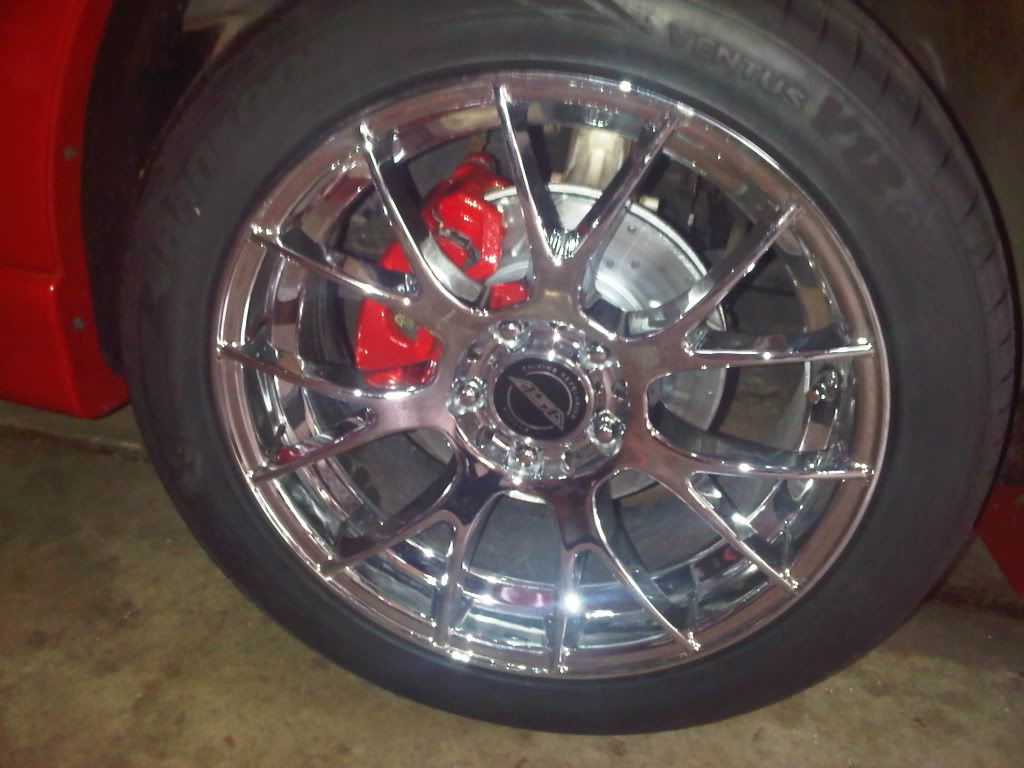
I bought drilled and slotted stock sized rotors from brakeperformance.com, painted the stock calipers and used cermaic premium pads. The braking performance is awesome and didnt cost much.
 
i might do that, but i still would like to know the banjo bolt to buy, and if the stainless steel lines are worth it. and what length also. i guess i should have put this in my first post. oh well


for a car with old, weak rubber lines, sure.

if the lines are new and crisp you won't notice much difference. only old lines balloon and screw up pedal feel.
 
well my car is 5 years old with about 95000 miles. the pedel feels fine. but i have the keep this car for another 5 years or so, so i guess i might have to get them.

zzp sells them but they are like $100 or more. and autozone sells some stainless steel lines also, but they are universal but you can pick the length you want or need. has any one used those before?
 
^autozone sells them.......enough said. Unv fit doesn't fit 90 percent of the time. Probably shouldn't go cheap when its related to brakes
 
Back
Top