• The site migration is complete! Hopefully everything transferred properly from the multiple decades old software we were using before. If you notice any issues please let me know, thanks! Also, I'm still working on things like chatbox, etc so hopefully those will be working in the next week or two.

Pulstar Spark Plugs.....Gimmick or legit?

GeddyLee

New member
I was looking through my Motor Trend mag this month and found this ad for Pulstar Plugs. I went to their website Pulse Plugs - 20,000X More Powerful Than Spark Plugs. Greater Horsepower, Fuel Efficiency, Torque. to see what others thought about these plugs.

I know Lee is a spark plug fanatic, and I know Scotty has some interest too, so I wanted to get your all's take on them. It almost seems like the old saying, "almost to good to be true."

Here is a comparision picture of their plug to a regular spark plug.
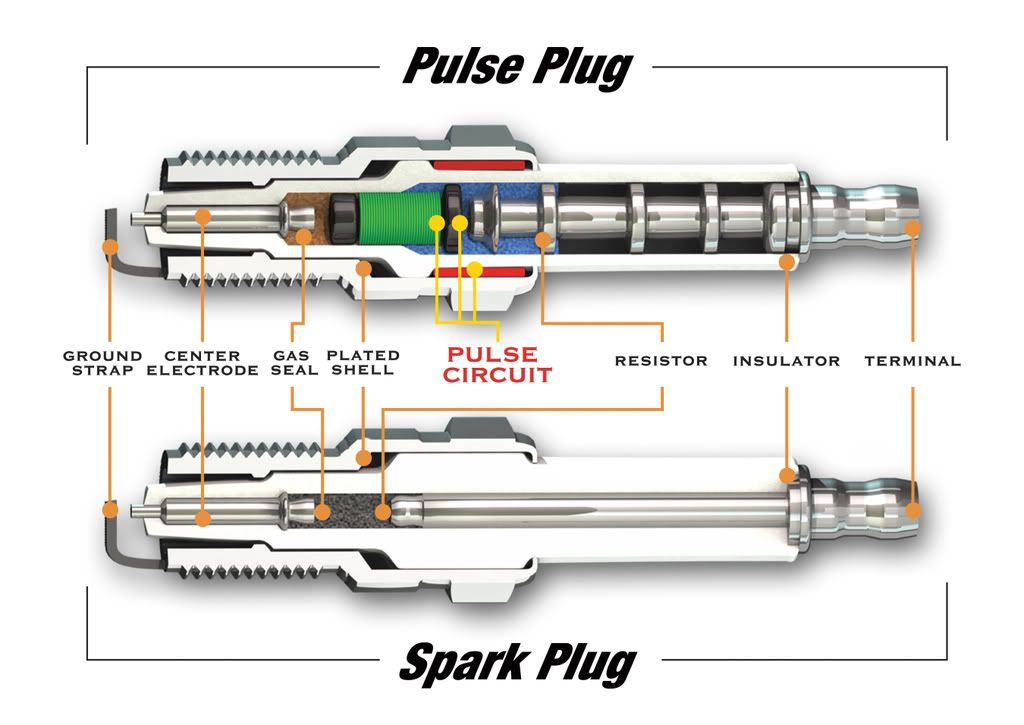
Comparison.jpg


Here are some of the quotes I got from their site.

Pulse plugs incorporate a pulse circuit, which stores incoming electrical energy from the ignition system and releases the stored energy in a powerful pulse of power. Instead of 50 watts of peak power typical of all spark plugs, pulse plugs deliver up to 1 million watts of peak power. So where does the pulse plug get its incredible power?

When the ignition signal is sent to a traditional spark plug, it begins to ionize the spark gap. This means that the voltage builds in the gap until a spark can be formed. During this ionization phase, which lasts about 5 millionths of a second, the incoming voltage (which has nowhere to go) heats up ignition components including the spark plug. This is wasted energy. When the ignition voltage overcomes the resistance in the spark gap, the spark is created with an initial discharge of approximately 50 watts. Once created, the spark resides between the electrodes at very low power for over a period of 30 millionths of a second.

What is different about a pulse plug is that instead of heating ignition parts during the ionization phase, this energy is stored in the integral circuit inside the pulse plug. When the ignition power overcomes the resistance in the spark gap, the pulse circuit discharges all of its accumulated power - 1 million watts - in 2 billionths of a second!

A simple way to think about pulse plugs is that they are similar to a camera flash, whereas spark plugs are more like a flashlight. A camera flash is exponentially brighter than a flashlight even though they both may use the same battery.

Tests at an independent laboratory demonstrate how Pulstar™ pulse plugs burn fuel more efficiently than spark plugs. In this high-speed video (shot at 68,000 frames per second), you can actually see the ignition plume of Pulstar™ growing at more than twice the speed of the spark plug. Pulstar™ generates a much larger spark than spark plugs, which reduces overall burn time and burns the fuel more completely. Once created, the spark dissipates over a period of 30 millionths of a second.

With increased cylinder pressure, the pistons are pushed down with more force, which, in turn, generates more torque in the crankshaft, more liveliness to the throttle and more power to the wheels.

Of course, if you don't use this torque to go faster, the engine does its work with less effort resulting in better fuel economy.

Another way that Pulstar™ improves efficiency is by reducing cycle-to-cycle variation. Cycle-to-cycle variation occurs in every engine to some degree and is caused by the dynamics of combustion, load, fuel quality, mixture of air to fuel and many other combustion variables. These variables can cause the spark plug to generate a weak spark and in the worst case, a misfire. This variability in ignition timing robs all spark ignited, internal combustion engines of up to 10% of their efficiency.

I know there were a lot of hopes for the Brisk plugs, I just thought I would put these out here and see what our community thought of them :)

I also wanted to include their FAQ Page.

FAQ Answers Questions About Installation and Use of Pulse Plugs as Aftermarket Auto Part

I also went ahead and looked at the cost of these plugs...............WOWZA $24.95 A PIECE!!! And they said this about the gapping on our cars.

Gapping: Set the Pulstar™ pulse gap specified above for your vehicle. Never exceed a gap of .040" with Pulstar™ plugs.
 
Last edited:


Well Im actually glad you posted this cause I have ran across these before and I have replied to posts about them before, not here of course, but here goes.

1 Million Watts of Power

First, simple electrical/electronic math will show you this is going to be a stretch at best. To achieve 1 million watts of spark power, in a 12 volt system you would need over 83,000 amps into virtually no resistance. But lets assume they are working from the secondary side of the coil. I believe the output voltage there is something along the lines of 38,000 volts. Even then you are going to need over 26 amps into around 1400 ohms of resistance.

I dont know if any of you have ever measured OEM plug wire resistance, but it is on the order of 1500 ohms PER FOOT. MSD wires come in around 50 ohms per foot. So anything longer than the #1 plug wire would have too much resistance to deliver that kind of power.

The only way to really achieve this, that I see is with a purely capacitive discharge ignition system and even then our electrical system cannot deliver the voltage or current that is needed, at least not with the current output capability of our coils.

Energy stored in the plugs

Their information says the 1 million watts is stored in the circuitry of the plug. The only device that I am aware of that could store that kind of power is a capacitor. However, one small enough to fit inside the confines of a spark plug AND store that kind of energy is a stretch for me. I could be wrong, but I just dont see it happening. Additionally, since the plug is supplied with power from the secondary side of the coil, it would take more than one discharge from the coil to build up that kind of power. That begs the question, what about all the other times the plug should be firing.

Based on what I know, however limited that might be viewed as, I dont see it happening.

As well, the cost is prohibitive. Can you imagine spending some $150 on a set of plugs and not getting anything out of it? I wouldnt buy them personally, but if they were to ship me a set to try out, Id give them a fair shake. But I wont hold out any hope they do what they say they will do.
 
The best most reliable thing you can do to your ignition system is up the output voltage of the coils, use low resistance plug wires and copper core plugs. More voltage means wider gap and better burn which translates to a bit more power and likely better fuel economy. The low resistance wires ensure that what the coils put out isnt getting eat up by the resistance of the wires.

Looking at the picture above, that is definitely a capacitive set up in the plug and I just dont see it being able to do what they say. I would rather spend my money on a MSD ignition box that does use a capacitive set up and can deliver what they say.
 
I too was curious, but not curious enough to part with that kind of money, and Scotty I agree they do seem to be making claims that are almost science fiction
 
Yeah these were posted before on ClubGP. Gimmick of the highest order. Ever since the spawn of Splitfire, people have realized that there are hordes of suckers out there willing to spend ridiculous money on spark plugs if they can fabricate some fancy sounding claims and "independent tests".

Even if they generate as much as they claim (and I doubt it) that means those plugs will wear out REALLY fast.

Another practical consideration is all of the circuitry in the plug itself. Making it more complex like that means there are more parts to fail. And with the amount of heat the plugs are subjected to that won't help things. Also there are 6 plugs so that multiplies the chances for failure even more.

If they produce a bajillion volts why do they have to say: "Never exceed a gap of .040" with Pulstar™ plugs." A crappy GM HEI system from the 70's has enough power to jump a gap of .065".

:th_BSflag-small:
 
Good deal. I was wondering. There is no way I would have shelled out a $150 bucks to get these things anyways to have them only last 50,000 miles anyways. But as I said at the top, it seemed almost to good to be true. And my hunch was right :)

Thanks for sharing your input :)


Well, you have to sort through them really. There are some out there with very solid ideas and production. BRISK seems to be one of them, the E3 plugs with their open end to the combustion chamber is another good design. As well AC/Delco made (they may still do but Im not sure) a plug called a Rapid Fire plug. Its features were it was 1 mm longer for better combustion chamber exposure and it was slightly sidegapped.

Sidegapped plugs are still the best least expensive option out there short of using better conductive metals. I make it no secret I am no fan of the exotic metal plugs (irridium, platinum, etc.). Ive used sidegapped plugs for a long time now and any plug that incorporates that feature in some way is okay with me. That is to say that the spark is exposed vertically to the combustion chamber rather than horizontally. You get a better flame front that way.
 
1 Million Watts of Power

First, simple electrical/electronic math will show you this is going to be a stretch at best. To achieve 1 million watts of spark power, in a 12 volt system you would need over 83,000 amps into virtually no resistance. But lets assume they are working from the secondary side of the coil. I believe the output voltage there is something along the lines of 38,000 volts. Even then you are going to need over 26 amps into around 1400 ohms of resistance.

FINALLY! Someone else who can do the math. Have a look here at this tool who claims he's pushing over 3kwatts in audio, while giving me **** at the same time...

ClubGP Message Forum troubleshooting

Check out the Joseph idiot...
 
As well AC/Delco made (they may still do but Im not sure) a plug called a Rapid Fire plug. Its features were it was 1 mm longer for better combustion chamber exposure and it was slightly sidegapped.

they killed that plug to to the fact it was a horrible failure (fouling was very common, and they didn't last long)


they killed that plug to to the fact it was a horrible failure (fouling was very common, and they didn't last long)

I was wondering why it wasnt around any longer. I tried them shortly after they came on the market. There was some big magazine write up about them and I tried them out. I really liked them, never had any problems when I used them, but it was the only set I used, and I do believe it was in my last grand prix, but dont hold me to that. It was, at least initially, a very good design.
 
I had a set in a quad 4 and a 3.1 and both ate them up, did some research and found a ton of other people with the same issue, then at the dealer we started getting cars in with them like that too
 
But iridium is what came stock in your car.

Well that could be I suppose, and if I had bought the car brand new and if it had those plugs in it, my first stop would have still been at Autozone or Wal-Mart to pick up copper core plugs.

The exotic metal plugs do not conduct electricity well at all and I want as much of the secondary coil voltage to reach my plugs as possible. Plug wires are another choker. The OEM plug wires are so high in resistance that its like trying to such the proverbial bowling ball through a garden hose.
 
they killed that plug to to the fact it was a horrible failure (fouling was very common, and they didn't last long)

just beware--- the "RAPIDFIRE" name is still in use by ac deco, for their standard platinum plug.

...the "standard" platinum plugs are one of the dumbest things out there. i can understand that in N/A motors, the platinum plugs are OK. however, the "standard" platinum plugs only have some platinum on the electrode side, not the ground strap side... which is totally useless in a waste-spark system such as we have, since the spark on some plugs actually travels from ground strap to electrode... so people buying the "standard" platinum instead of the double/professional platinum plugs are getting the shaft man!


Oh yeah if plopped down $150 bucks + shipping. I would be cursing up a storm. I knew when I read the article, it seemed interesting, but in the back of my mind I kept thinking it was to good to be true. Guess that link proved that :D
 
Well that could be I suppose, and if I had bought the car brand new and if it had those plugs in it, my first stop would have still been at Autozone or Wal-Mart to pick up copper core plugs.

The exotic metal plugs do not conduct electricity well at all and I want as much of the secondary coil voltage to reach my plugs as possible. Plug wires are another choker. The OEM plug wires are so high in resistance that its like trying to such the proverbial bowling ball through a garden hose.

Then you would be wasting your time and money pulling out a good set of iridium plugs. Where do people come up with this stuff? And since the ICM has a current limiting circuit putting lower resitance wires on if your OEM's are in good condition is a waste as well.
 
Back
Top