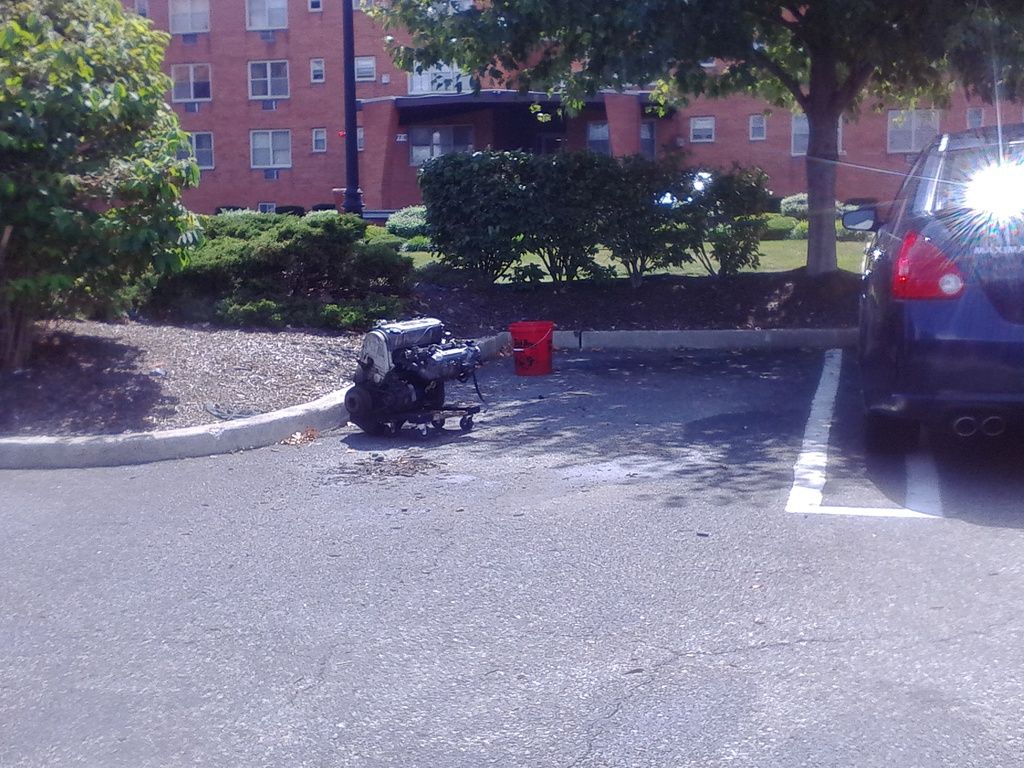
Sorry if I'm using the wrong terminology, I believe the rod bolts are what connect the cap to the connecting rod. And that's what my mechanic said, I would assume he (and you) are right in saying that motor is done for but if I'm able to get it to run for a few thousand (or hundred) more miles then we can ditch it and find something else, I don't think I can lower the value of the car by trying. I've been able to find a supplier that could ship the same motor w/90k miles for almost $500 even, however, I really am limited with tools and would not be able to perform a motor swap (as much as I would love to). I haven't actually gone underneath to see what is needed or if I can even access anything so thank you for the heads up. This would definitely make things more difficult. Thank you kind sir for the advice, I really appreciate it!
I've rebuilt two of these engine's that are both still on the road, so first off, it's possible. The one in my car is rolling on 8,000+miles. Do I recommend it to the average person looking to "get a few more miles"? No. I rebuild mine with a very experienced machine shop behind me, and even after spending $1500 rebuilding it, I cut one corner and didn't replace the valve guides, and now I'm going to have to pull the heads again to fix it.
The following information is not from me, but my machinist who has 30+years in the business of rebuilding engines. I know you've probably seen a couple youtube videos by slightly disingenuous folks who never actually show you what happens 500 miles after it's "rebuilt". You would think that your solid engine will always stay exactly like it was factory and the bearings must be the only thing wrong. That thinking couldn't be farther from the truth. As your engine ages, two main things happen to the rotating assembly. The crankshaft, bearings, and connecting rod wear, and the connecting rods stretch. Though you can't really see it with the naked eye, the connecting rods actually start to become more and more oval rather than round. Even on a perfectly healthy engine, you cannot simply remove the connecting rods and throw in new bearings for this reason. In order to actually fix it, the machine shop grinds the portion between the cap and connecting rod to bring it back "into round", then you can replace the bearing, if and only if the crankshaft is within clearance and not damaged.
Now, I've been talking a lot on clearance, so why is it important? Well, lots of reasons, but namely oil pressure. If your clearances are too big, you get low oil pressure, the various surfaces are allowed to touch and they grind together and heat up and eventually seize together and break. By just replacing the bearings without correcting for the wear in your engine and bringing these clearances back into tolerance, your engine WILL fail, and soon.
Also, when your engine "knocks", you're really hearing the connecting rods bang downward across this excess clearance over and over, and most likely if there's even any bearing left, the crankshaft has been damaged, most likely beyond repair. Your bearings also have the likelyhood of spinning, in which they are supposed to remain stationary since one bearing has an oil feed hole, but they break loose and spin around, causing massive damage to the crankshaft.
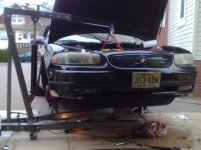
Around here, on half off days, you can get a good engine for $100-200 from the junkyard. It can be a chore the first time, but it's also fun and rewarding, and you don't need any crazy tools, just basic hand tools. The only real "special" tool you need to do an engine swap is a lift, which you can either rent, or it's $150 at harbor freight (cheaper if you check craigslist).
Normally I preface with "I'm not telling you what to do", but here I am. You WILL waste your time and money on just replacing the bearings, and I can tell you, replacing them in the car is just as hard as installing a new engine. Aslo, the rod bolts are 100% torque to yield, which means that they are one use ONLY. They also cost most what your used engine hoist would. Save your time and money, replace that engine.
Sorry I had to be harsh, but it's the truth. Replacing an engine is not the hardest thing in the world and bill-boost has some great writeups that take you step by step, and we're all here to lend a hand should you have any questions.