• The site migration is complete! Hopefully everything transferred properly from the multiple decades old software we were using before. If you notice any issues please let me know, thanks! Also, I'm still working on things like chatbox, etc so hopefully those will be working in the next week or two.

3800 Series II non-SC runs hot after replacing lower intake gaskets and upper intake

BrianP

New member
2002 Grand Prix GT 4-door
3800 Series II non-SC
mileage: 225,181 (yes, that's correct! And I'm the original owner...)

This week I replaced the lower intake gaskets (used Felpro metal gaskets) and the upper intake and gasket. During the repair I also replaced the thermostat and coolant temp sensor. I mixed my own 50/50 Dexcool solution using distilled water (double-checked the Dexcool bottle to make sure I didn't accidentally by pre-mixed 50/50 before diluting).

After completing the repairs, the temp needle at full operating temp hovers and stabilizes between 210 and 235. Is there anything else that I missed that could be causing the overheat?

There is no bubbling in coolant tank that would indicate a blow head gasket, the oil is not cloudy, and the new coolant appears to be clean and not contaminated with any oil. While operating with radiator cap off and thermostat open (I know this is not recommended...) I can observe coolant down in the filler neck coming steadily out of the radiator passages, so that's confirmation to me that the thermostat opens as it should.

One step I haven't tried is to plug the car in to an OBD that can read coolant temp, to determine if I have a false reading on the instrument cluster dial.

I'm considering radiator replacement as the next option, although there are no coolant leaks at this point. My last radiator replacement was in 2011.

I feel like I've been pretty thorough on this repair, but any other ideas?
 
Last edited:


Be sure to bleed the coolant system.
Turn the car on let it get to operating temp/ till the t-stat opens up and turn the bleeder screw ontop of the tstat housing till a steady flow of coolant comes out, then close it.
 
Per Scotty- open the rad cap, let the car idle till the fans come on, then open the bleeder screw till a solid stream of coolant comes out. then shut the screw, top off the rad,and cap it.
 
I'm beginning to think that my coolant mixture may not be 50/50. What is the likelihood that the "full strength" bottle of Dexcool was already pre-diluted, and I've diluted even more when adding the distilled water? Has anyone ever had this happen?


That still won't cause the temp to rise.


I'd just go drive the car, see what it does. Half the time at work I don't even use the bleed screw anymore, just run it with the cap off for a little bit to top off the coolant and close it up and go for a drive. If for some reason the temp climbs real quick, I just swing it back into the shop and let it cool down a little, pop the rad cap back off and top off the coolant. Most of the time the air pockets move around alot once you drive it and let it cool down.
 
Thanks. I've read forums on other pages where people think they have a faulty gauge on the instrument cluster. How likely is this scenario?
 
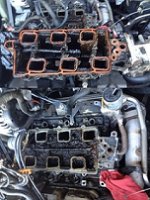
For fun, here are a couple of pics showing all the crud in the UIM and LIM...

attachment.php
 

Attachments

  • IMG_4691.JPG
    IMG_4691.JPG
    47 KB · Views: 104


210-235, I don't think that's anything to worry about? If it stabalizes you will be OK. Still may be a little air, I would just drive it and keep an eye on it. What were you used to seeing?
 
Bandook, normal operating temps on the instrument cluster needle have been at, or slightly above, the 185 degree marker. At the warmest it would sometimes jump up to almost the 210 mark (210 is the halfway mark on the cluster needle), but never over unless I was low on coolant.
 
what t-stat was in it before? made it had a cooler stat and went with a factory one and now it running where it should be?
 
Bandook, normal operating temps on the instrument cluster needle have been at, or slightly above, the 185 degree marker. At the warmest it would sometimes jump up to almost the 210 mark (210 is the halfway mark on the cluster needle), but never over unless I was low on coolant.

My first long drive after my lim job mine got up to 225. I kinda freaked too. But it hasn't done it since. I still think you just have a little air. How many miles have you put on it since?


How did you fill the system up? You may have vapor lock in your system. It'll look like everything is full but run hot. I ran into this after I swapped my motor. I filled up the coolant though the LIM with the tstat housing taken off and the rad cap on. Then you can bleed as normal.
 
My first long drive after my lim job mine got up to 225. I kinda freaked too. But it hasn't done it since. I still think you just have a little air. How many miles have you put on it since?

I've only put about 20-30 miles on it so far. I'm still nervous about getting to far away from home.
 
How did you fill the system up? You may have vapor lock in your system. It'll look like everything is full but run hot. I ran into this after I swapped my motor. I filled up the coolant though the LIM with the tstat housing taken off and the rad cap on. Then you can bleed as normal.

I filled the system at first through the LIM thermostat port, then through the radiator filler neck. I opened the bleeder valve on the thermostat housing until a steady stream of coolant poured out. Am I missing a step somewhere?
 
Update:

Replaced the radiator cap, followed directions from multiple suggestions above for bleeding until steady stream comes out, still getting high temp reading on the cluster needle...staying between 210-235...

I just picked up a loaner block tester. Next step is to test the right way for a blown head gasket.

How much damage can i do if I drive it regularly at these current operating temps until I can find the right repair?
 
Back
Top