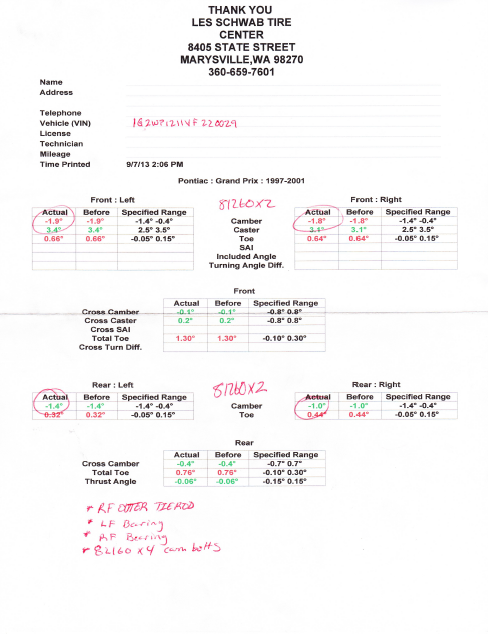
That's not at all what I'm asking.
What I'm asking is how lowering a car correctly would have the camber adjusted differently.
You state that you would not need camber bolts unless the factory bolts are somehow worn out.
So to get the camber back into factory spec, you'll need camber bolts, which are a cam like bolt, unlike the factory bolt which are standard bolts. Camber bolts are eccentric. If you wanted to run more than factory camber, then yes, you don't need camber bolts. I think that anything under 2* for a W body will be fine with proper tire pressure and rotations every oil change or two.
However to have your alignment "correct" and thus lower the car "correctly", you'd need to bring camber back within factory specs. The "right" way to do it is all dependent on your view, and mostly how deep your pockets are.
Arguably, enlarging one hole of the strut is sufficient. Arguably, that can shift over time, and an eccentric bolt is preferred. Arguably, that too can shift with a sudden jolt. Arguably, camber plates are the only way to hold reliable and measurable camber and caster adjustments. Arguably, camber plates are too pricey and sometimes not worth the metal they're made of depending on how it was designed.
Arguably, camber under 2* doesn't matter anyways. Toe is what you should focus on.