Impala131
New member
Hello all, I know a lot of people ask why you can't use regular gas in your GTP, and some insist that you can if you stay out of the boost. Well, you can... but it's not worth it. Although it's been said before, I'd like to provide actual proof rather than just being one of the GPF "common knowledge" parrots. This is going to be fairly lengthy, so you might just want to glance through it.
I started thinking about using 87 octane when I recently visited a small town in Tennessee where I will be working in the near future. Unlike MI where I was from, the difference between regular and premium is greater (25-35¢ per gallon), and many areas where you can't obtain it at all unless you drive out of your way. Some people have said that as long as you stay out of the boost, you can run whatever grade you want. As I understand it, the only difference between octane grades is resistance to detonation. Since I have HP tuners, I decided to conduct a loose experiment to find out how viable 87 octane is.
I own a 99 GTP. I started by putting a 3.8" pulley on my MPS. The other mods are headers, 605 plugs, and an open cone intake. I reflashed the PCM back to a stock tune. It's probably safe to assume that if I got knock on my setup... you will most certainly get the same or worse on a stock setup. I let my fuel tank reach nearly empty (the needle was completely below the E mark) and filled up with 10 gallons of 87 octane at my local Shell. Perhaps you can nitpick over the small amount of 93 octane in my tank. At the time of tuning, it was 42* outside, with IATs of 60-70*. My ECT stayed around 185-190*
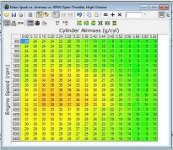
I then drove my car carefully and followed our forum's MAF tuning method. I found out relatively quickly that the "as long as you stay out of the boost you're fine" theory didn't hold any water for my vehicle. On flat surfaces, I was fine. However, slight uphills, shifts, somewhat sudden throttle changes... all produced small amount of KR. I once peaked 4* on a shift. This was all at very low throttle levels. (Less than 20%) I responded by reducing the timing advance by subtracting from all the cells that had KR. When my part throttle/MAF tuning was done, I had somewhat butchered my High Octane timing table already. I was, however, able to add some timing to the cruise tables that effect the highway cruising gas mileage the most. It seems that my car had the most trouble with the high airflow with low engine speed scenarios.
For the WOT tuning, I knew I would have problems, so I cut back the timing for WOT by quite a bit (And cleared the adder tables). I also ran much richer than I would ever really want... I got it to about 11.2. I purposely ran rich though so I could get away with as much timing as possible for the sake of this experiment. The most timing I could push was a bit less than stock levels, which, most L67 people will tell you is bad, because according to them, stock timing should be considered a minimum. To put it in perspective, my car (93 octane) ran 17* of timing on a 3.6" pulley and 11.5 AFR with zero knock prior to this experiment.
I continued to cut timing from all areas that experienced knock. I'll link it below for you to see for yourself. Again, remember that the timing adder tables are zeroed out. Anyone familiar with tuning these cars will tell you that this table is pretty bad.

Now, from a cost standpoint...both the cost of gas per gallon, and fuel economy, are the important factors. From a purely cost savings perspective (lets ignore the wear/engine damage from knock, say you have a relatively safe 87 octane tune) all you care about it how much it costs you to drive a certain distance. If you divide cost per gallon by miles per gallon, that eliminates the "gallons" from the equation... and gives you cost per mile. It makes the most sense to read it in pennies. Then you can compare apple-to-apples the cost savings of running one grade over another.
I created an excel chart to make this easy. Just fill in the green box with the most accurate information you can, and look at the blue box. Suddenly, regular gas doesn't net much of a savings. Although I was able to get approximately the same gas mileage on both grades on the freeway, other members on various forums reported a 2mpg loss as typical, so that's the default in the table. I used the extreme Tennessee example for the table's defaults.
Excel
So, to summarize, I just can't see enough justification to switch to regular. Now, mid-grade (which already fairly close to the cost of premium anyway) may allow you to run stock timing in most of the non-boost cells on a car with headers and rockers/cam, although if you consider the point of a mod like a cam, it just doesn't make sense. And, keeping out of the boost is not enough to protect it from this more volatile fuel. That $4 we save over the course of 1000 miles is just not worth it, IMO. Now I get to drive like an old lady for the holiday season until I get it out of my system and fill with the correct grade.
I started thinking about using 87 octane when I recently visited a small town in Tennessee where I will be working in the near future. Unlike MI where I was from, the difference between regular and premium is greater (25-35¢ per gallon), and many areas where you can't obtain it at all unless you drive out of your way. Some people have said that as long as you stay out of the boost, you can run whatever grade you want. As I understand it, the only difference between octane grades is resistance to detonation. Since I have HP tuners, I decided to conduct a loose experiment to find out how viable 87 octane is.
I own a 99 GTP. I started by putting a 3.8" pulley on my MPS. The other mods are headers, 605 plugs, and an open cone intake. I reflashed the PCM back to a stock tune. It's probably safe to assume that if I got knock on my setup... you will most certainly get the same or worse on a stock setup. I let my fuel tank reach nearly empty (the needle was completely below the E mark) and filled up with 10 gallons of 87 octane at my local Shell. Perhaps you can nitpick over the small amount of 93 octane in my tank. At the time of tuning, it was 42* outside, with IATs of 60-70*. My ECT stayed around 185-190*
I then drove my car carefully and followed our forum's MAF tuning method. I found out relatively quickly that the "as long as you stay out of the boost you're fine" theory didn't hold any water for my vehicle. On flat surfaces, I was fine. However, slight uphills, shifts, somewhat sudden throttle changes... all produced small amount of KR. I once peaked 4* on a shift. This was all at very low throttle levels. (Less than 20%) I responded by reducing the timing advance by subtracting from all the cells that had KR. When my part throttle/MAF tuning was done, I had somewhat butchered my High Octane timing table already. I was, however, able to add some timing to the cruise tables that effect the highway cruising gas mileage the most. It seems that my car had the most trouble with the high airflow with low engine speed scenarios.
For the WOT tuning, I knew I would have problems, so I cut back the timing for WOT by quite a bit (And cleared the adder tables). I also ran much richer than I would ever really want... I got it to about 11.2. I purposely ran rich though so I could get away with as much timing as possible for the sake of this experiment. The most timing I could push was a bit less than stock levels, which, most L67 people will tell you is bad, because according to them, stock timing should be considered a minimum. To put it in perspective, my car (93 octane) ran 17* of timing on a 3.6" pulley and 11.5 AFR with zero knock prior to this experiment.
I continued to cut timing from all areas that experienced knock. I'll link it below for you to see for yourself. Again, remember that the timing adder tables are zeroed out. Anyone familiar with tuning these cars will tell you that this table is pretty bad.
Now, from a cost standpoint...both the cost of gas per gallon, and fuel economy, are the important factors. From a purely cost savings perspective (lets ignore the wear/engine damage from knock, say you have a relatively safe 87 octane tune) all you care about it how much it costs you to drive a certain distance. If you divide cost per gallon by miles per gallon, that eliminates the "gallons" from the equation... and gives you cost per mile. It makes the most sense to read it in pennies. Then you can compare apple-to-apples the cost savings of running one grade over another.
I created an excel chart to make this easy. Just fill in the green box with the most accurate information you can, and look at the blue box. Suddenly, regular gas doesn't net much of a savings. Although I was able to get approximately the same gas mileage on both grades on the freeway, other members on various forums reported a 2mpg loss as typical, so that's the default in the table. I used the extreme Tennessee example for the table's defaults.
Excel
So, to summarize, I just can't see enough justification to switch to regular. Now, mid-grade (which already fairly close to the cost of premium anyway) may allow you to run stock timing in most of the non-boost cells on a car with headers and rockers/cam, although if you consider the point of a mod like a cam, it just doesn't make sense. And, keeping out of the boost is not enough to protect it from this more volatile fuel. That $4 we save over the course of 1000 miles is just not worth it, IMO. Now I get to drive like an old lady for the holiday season until I get it out of my system and fill with the correct grade.